Products, Solutions & Services for the
Canadian Gas Energy Industry
Discover Shop.CRWall.com
A Digital Marketplace featuring 1000’s of Products & Solutions
Products, Solutions & Services for the Canadian Gas Energy Industry
Discover Shop.CRWall.com
A Digital Marketplace featuring 1000’s of Products & Solutions
Education and Solutions - New Blog
Why are Canadian gas utilities replacing turbine meters with ultrasonic technology?
Utilities across Canada are re-evaluating turbine meters due to ongoing maintenance requirements, mechanical wear, and limitations in handling wide flow ranges. In exploring this industry shift, CR Wall sat down with a product expert from Endress+Hauser to better understand what is driving the move. Ultrasonic gas measurement is emerging as a preferred alternative, offering no moving parts, wider turndown capability, lower pressure loss, and built-in diagnostics for improved system visibility, helping utilities achieve more reliable, efficient, and data-driven operations as networks modernize.
Explore The Facts, Learn From The Experts
Recent Topics
Reliable H₂S measurement has historically been challenged by issues like sensor drift, contamination, and ongoing maintenance requirements, all of which can introduce risk in gas quality monitoring. The JT33 was developed to address these limitations by using tunable diode laser absorption spectroscopy (TDLAS) to deliver continuous, real-time measurement without direct contact with the gas stream. This approach improves accuracy, reduces maintenance, and enhances safety and compliance confidence for Canadian natural gas operators.
Natural gas meters vary by measurement principle, accuracy, pressure capability, and ideal flow range, making each type better suited to specific applications within a distribution system. From diaphragm meters for residential service to ultrasonic, rotary, turbine, and Coriolis meters for higher flow and pressure environments, each technology has clear operational strengths and limitations. Selecting the right meter depends on system requirements such as load profile, data needs, redundancy considerations, and long term performance expectations.
Smart metering is growing in Canada because it improves safety, billing accuracy, and operational efficiency while reducing manual meter reading and emissions. Utilities gain better data for forecasting, leak detection, and system planning, and customers benefit from real-time insights and fewer service disruptions. Aging infrastructure and regulatory pressure for modernization further accelerate adoption.
Hydrogen blending is an innovative technology that’s gaining attention for its ability to lower emissions in Canada’s natural gas industry. By injecting hydrogen into existing pipelines, it reduces the carbon intensity of delivered energy without requiring major infrastructure changes. This makes it a compelling solution for utilities looking to decarbonize while maintaining reliable service.
Natural gas will remain a key part of Canada’s energy future due to its environmental benefits, especially with the growth of Renewable Natural Gas (RNG). It’s safe, reliable, cost-effective, and more efficient than many alternatives, with appliances that experience fewer outages. Canada also has an abundant supply—enough to last about 300 years—and continues to lead in environmentally responsible production practices. Technological innovations like LNG have further strengthened the case for natural gas as a long-term energy solution.
Proudly Supporting Canada's Gas Energy Industry
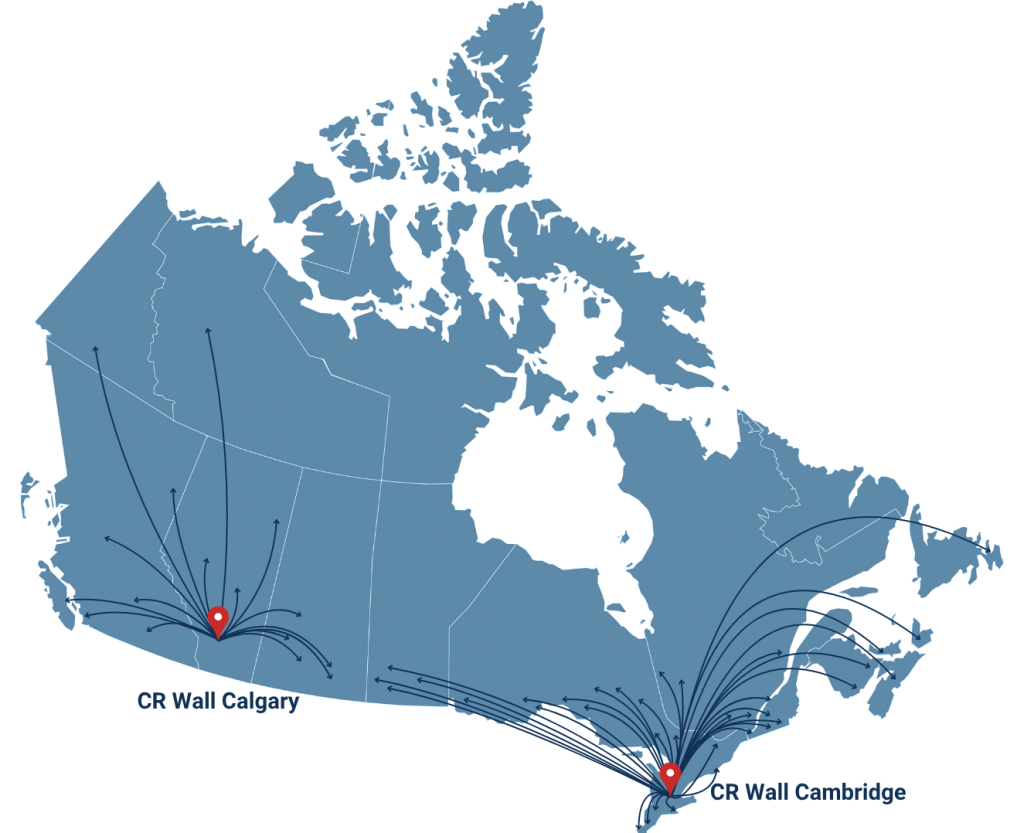
Trusted By Customers From Coast To Coast
Proudly Supporting Canada's Natural Gas Energy Industry
Trusted By Customers From Coast To Coast
We Service What We Sell
Trust CR Wall for your calibration, repair, installation, and training needs.
Acknowledgement
We recognize the sovereignty of First Nations, Métis, and Inuit Peoples and commit to learning, listening, and building a just future together.