

Table of Contents
Introduction
Natural gas metering is changing.
Across Canada, utilities, contractors, and industrial gas users are being asked to do more with their measurement systems. They need accurate data, reliable equipment, shorter installation timelines, strong diagnostics, and technologies that can support future energy blends such as hydrogen and renewable gases.
That creates a common challenge: how do you reduce uncertainty in a metering application when pressure, temperature, gas composition, installation space, maintenance expectations, and project timelines all need to be considered?
For many utilities, Coriolis metering is still a relatively new option in natural gas applications. Rotary, turbine, diaphragm, and ultrasonic meters are more familiar. But as the industry looks for alternatives that offer high accuracy, compact installation, and lower maintenance, Coriolis technology is becoming part of the conversation.
To explore where Coriolis metering fits in the Canadian natural gas market, CR Wall spoke with Mike Miller, Product Specialist at Endress+Hauser.
As Mike explained, the biggest difference comes down to how the meter measures hydrocarbons. “Coriolis is a mass flow measurement. That’s the biggest difference.”
That point is central to understanding the technology. Coriolis metering does not simply offer another way to measure gas flow. It offers a different starting point for measurement.
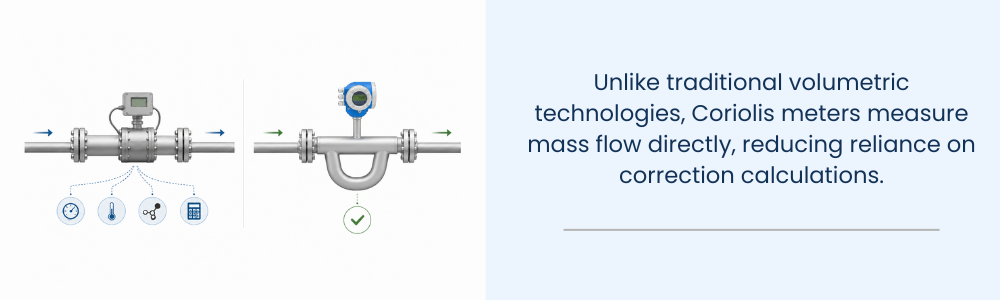
Why is that important? In most traditional gas metering technologies, the meter measures volume first and then relies on pressure, temperature, and gas composition data to calculate the final measurement. A Coriolis meter takes a different approach by measuring mass flow directly. This can simplify the measurement process and minimize potential errors introduced through multiple correction calculations.
What is Coriolis Metering?
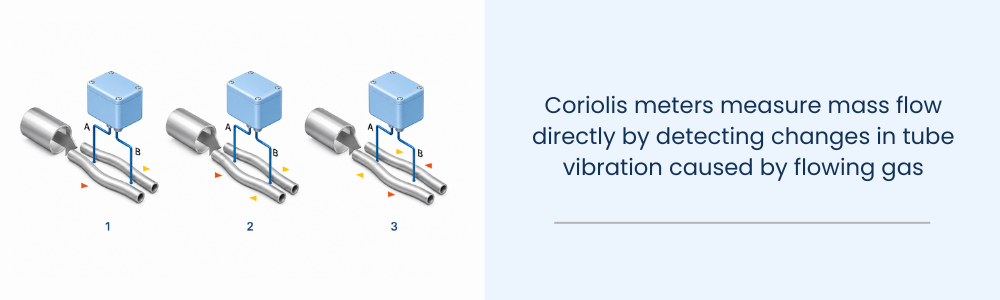
A Coriolis meter measures flow by detecting how fluid or gas moving through vibrating tubes affects their motion.
Mike described it using a simple image: picture a garden hose or fire hose moving as flow passes through it. The faster the flow, the more noticeable the movement. Inside a Coriolis meter, the instrument measures the shift in vibration between different points on the tube. That phase shift is used to calculate mass flow.
In simple terms, the meter is not counting mechanical rotations or measuring velocity through a path. It measures the effect of moving mass through a vibrating tube.
That makes Coriolis different from many common natural gas meter types:
- Rotary meters measure volume through mechanical displacement.
- Turbine meters measure flow based on rotor speed.
- Diaphragm meters measure volume through chamber movement.
- Ultrasonic meters measure flow velocity using sound signals.
- Coriolis meters measure mass flow directly.
This is one reason Coriolis meters can be attractive in applications where measurement confidence, compact design, and diagnostics are important.
Why Mass Flow Matters In Natural Gas
Natural gas is highly compressible. Pressure, temperature, and gas composition all affect how gas behaves. In traditional volumetric measurement, these variables often need to be corrected to calculate standardized volume, mass, or energy.
Because a Coriolis meter natively measures mass flow, it can reduce the need to convert a volumetric measurement into a mass measurement. As Mike put it, “That part of the picture of measurement error gets removed from the equation.”
In other words, instead of first measuring how much space the gas occupies and then applying correction calculations, a Coriolis meter measures the actual mass moving through the meter directly.
This does not mean meter sizing, gas composition, pressure, or temperature no longer matter. They absolutely do. A Coriolis meter still needs to be selected based on actual operating conditions, including flow range, pressure, temperature, gas density, seasonal demand, and acceptable pressure drop. But it does mean Coriolis meters can offer a different measurement approach, one that may be useful where accuracy and confidence are priorities.
Before looking at the individual advantages, it helps to think about Coriolis metering in practical terms. For utilities and contractors, the value is not only in the meter’s accuracy. It is in how the technology can reduce complexity across the full application, from design and installation to maintenance and long-term verification.
Key Advantages of Coriolis Meters for Natural Gas
1. High Accuracy
Coriolis meters are known for strong measurement accuracy. According to Mike, certain Coriolis options can achieve accuracy “as low as 0.25%” depending on the model and application.
For custody transfer, industrial, and commercial applications, this level of measurement confidence can be important. Small errors in gas measurement can become meaningful over time, especially in higher-value or higher-volume applications.
Not every application needs the highest-end Coriolis meter. Mike highlighted that there are different Coriolis sensor options available, ranging from more cost-effective models to higher-end custody transfer models. This allows customers to match the meter to the application, accuracy requirement, and budget.
2. No Upstream or Downstream Pipe Run Requirements
One of the most practical advantages of Coriolis technology is installation flexibility.
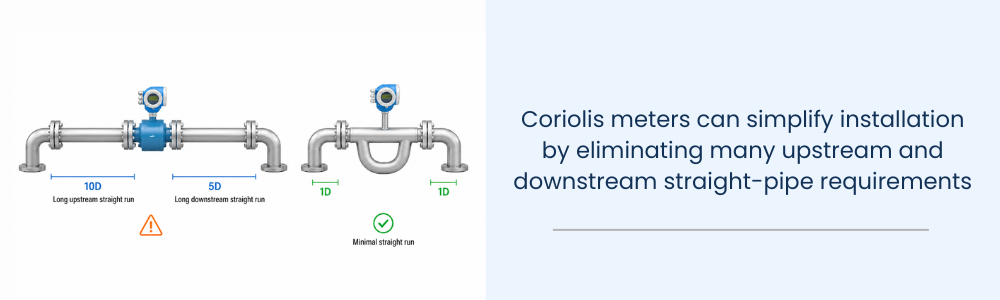
Many metering technologies require specific upstream and downstream pipe runs to achieve proper flow profiles. Real-world retrofit projects, mechanical rooms, district stations, industrial sites, and compact piping layouts do not always provide that space.
Coriolis meters do not require the same upstream and downstream straight-run specifications. This can help reduce piping complexity, shorten the overall footprint, and make installation easier in tight locations.
For greenfield designs, that can also influence total installed cost. A meter may have a higher upfront price, but reduced piping, supports, space requirements, and installation complexity can change the full project economics.
This is where Coriolis can shift the conversation from “what does the meter cost?” to “what does the full installation require?”
3. No Moving Parts
Coriolis meters have no moving parts in the flow path.
That means there are no rotors, gears, chambers, or mechanical components that can bind, wear, or fail closed. For utilities and contractors, this can reduce maintenance concerns and support long-term reliability.
Mike summarized it simply: “There’s nothing to bind, there’s nothing to break.”
This can be especially valuable in applications where access is limited, downtime is costly, or maintenance resources are stretched.
4. Strong Diagnostic Capabilities
Diagnostics may be one of the most underappreciated advantages of Coriolis metering.
According to Mike, Coriolis meters have “arguably the most available diagnostics within any measurement technology.” These diagnostics can help identify issues such as tube buildup, damage, erosion, or moisture concerns.
With Endress+Hauser Heartbeat Technology, users can run onboard verification checks and gain confidence that the device is operating as expected.
Mike noted that Heartbeat technology can check more than 100 points on the meter, including software, internal wiring, and electrical components.
For utilities and contractors, this supports a more proactive maintenance approach. Instead of waiting for a failure, diagnostic data can help identify early warning signs and reduce unplanned downtime.
For customers responsible for keeping gas systems operating safely and reliably, that visibility can be just as valuable as the measurement itself.
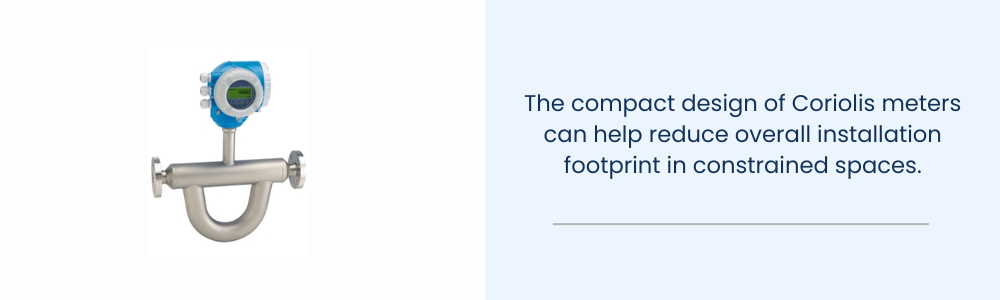
5. Compact Footprint
Because Coriolis meters do not require long straight pipe runs, they can be easier to fit into compact installations.
This matters in Canadian natural gas applications where space can be limited. Meter sets, industrial skids, station upgrades, and retrofit projects often need to be designed around existing equipment and site constraints.
A smaller footprint can also reduce construction complexity, which may help during busy projects or tight commissioning timelines.
Where Coriolis Meters Are a Good Fit
Coriolis meters will not replace every natural gas metering technology, and that is an important point. The value of Coriolis is not that it is the best answer for every metering point.
The value is that it can solve specific challenges that traditional technologies may not address as easily.
The right meter still depends on the application, line size, flow range, pressure drop tolerance, accuracy requirements, and budget.
However, Coriolis meters may be a strong fit for:
- Custody transfer applications where approved options are required
- Industrial and commercial gas measurement
- Compact installations with limited straight pipe availability
- Greenfield sites looking to reduce piping complexity
- Applications requiring high measurement accuracy
- Sites where onboard diagnostics and verification are valuable
- Hydrogen blend pilot projects or future-ready gas systems
- Locations where lead time is a major project constraint
Mike noted that Coriolis adoption is especially relevant where upstream and downstream piping space is limited, as well as in emerging hydrogen blend applications.
In other words, Coriolis becomes especially compelling when the project requires more than a basic flow measurement. It is strongest when accuracy, space, diagnostics, maintenance, and future flexibility all matter simultaneously.
Coriolis and Hydrogen Blending
Hydrogen blending is becoming an important topic in the natural gas industry. As utilities evaluate lower-carbon pathways, measurement technologies must be able to handle changing gas compositions and maintain confidence in the data.
Coriolis meters are already being considered for hydrogen blend applications. Mike explained that Coriolis technology has approvals for hydrogen blends and can incorporate gas-specific features to account for changes in gas properties.
The bigger point is not that every hydrogen blend application will automatically require Coriolis. It is that Coriolis offers a measurement platform that is well positioned for changing gas compositions, direct mass flow measurement, and high diagnostic visibility.
For Canadian utilities exploring future fuel strategies, that flexibility matters. A metering technology that can support today’s natural gas applications while also preparing for potential changes in gas composition may offer long-term value beyond the initial project.
What Canadian Customers Should Know About Approvals and Compliance
For Canadian natural gas applications, approvals matter.
Measurement Canada is the key authority for devices used in measurement-based trade. For custody transfer applications, utilities and customers need to confirm whether the specific meter and configuration are approved for the intended use.
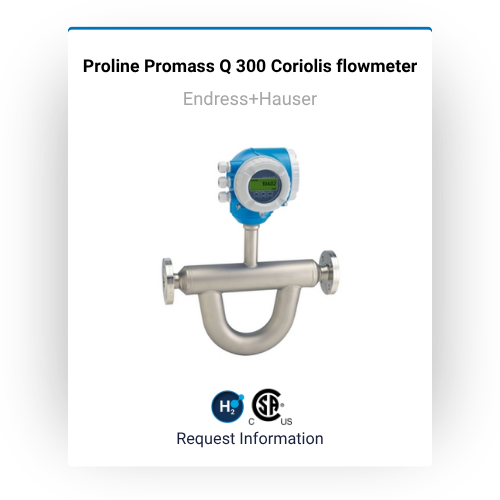
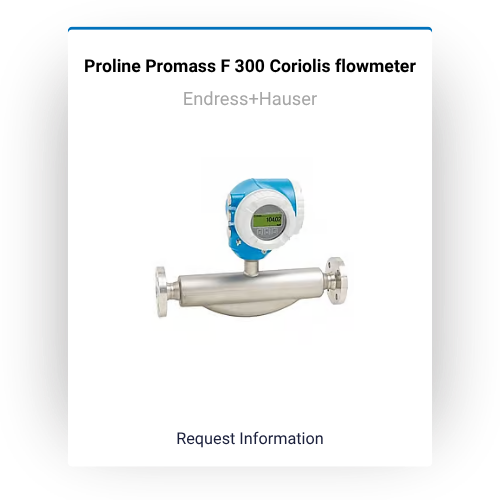
Mike confirmed that Coriolis meters are on the table for custody transfer applications where the appropriate approvals apply. Customers can reference the Measurement Canada Notice of Approval Database to search for current Coriolis meter approvals. The Endress+Hauser Promass Q Notice of Approval is AG-0662, and the Promass F Notice of Approval is AG-0647.
He also noted that recertification and verification requirements should be considered as part of the full lifecycle.
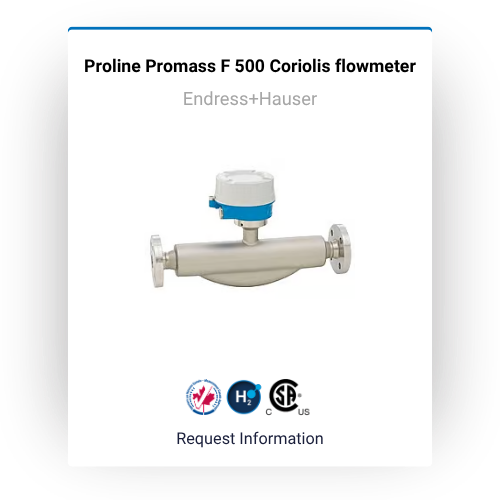
For Canadian applications, Promass meters also have CSA Class I, Division 1 and Class I, Division 2 options. In addition, they have current CRN approvals for pressure vessel requirements.
The practical takeaway is simple: involve the right experts early. Before selecting a Coriolis meter, confirm the approval status, application requirements, verification process, recertification expectations, hazardous location requirements, and pressure vessel compliance needs.
For non-custody transfer applications, onboard verification tools can still provide valuable confidence in meter health and performance, even when the regulatory requirements are different.
How to Size a Coriolis Meter Correctly
Sizing is one of the most important parts of a successful Coriolis installation.
A common mistake is thinking only about pipe size. Pipe size matters, but actual flow conditions matter more.
Customers should understand:
- Operating pressure
- Operating temperature
- Minimum and maximum flow rates
- Gas composition
- Gas density
- Compressibility data
- Required accuracy
- Allowable pressure drop
- Seasonal load variation
Mike described sizing as a “dance” between accuracy, cost, and pressure drop.
Sizing down can sometimes improve accuracy and reduce meter cost, but it can also increase pressure drop. Sizing closer to pipe size may reduce pressure loss, but it may also affect cost and performance depending on the flow profile.
This is especially important in gas applications, where pressure loss is often a major design consideration.
Canadian Operating Conditions: Cold Weather and Seasonal Loads
Canadian natural gas systems face operating conditions that are not always easy.
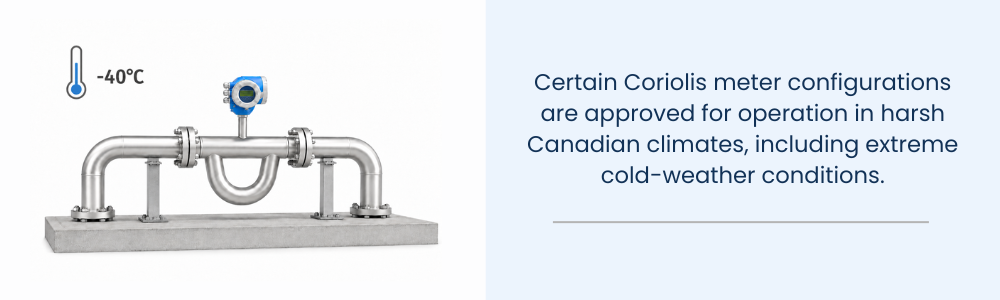
Cold weather, outdoor installations, remote sites, and seasonal load swings all need to be considered during meter selection. Coriolis meters are already used in demanding Canadian oil and gas environments, and Mike noted that some Coriolis meters have Measurement Canada approvals for outdoor operation down to -40°C, with certain models rated for temperatures as low as -50°C, making them well-suited for harsh Canadian climates.
Seasonal demand is another important consideration. Winter and summer loads can differ significantly, especially in distribution and commercial heating applications. Because Coriolis turndown is not always as wide as ultrasonic technology, accurate seasonal load data is important during sizing.
For remote sites, the considerations are similar to those of other advanced metering technologies. If power, piping, communications, and telemetry are available, Coriolis data can be integrated into broader measurement and monitoring systems.
What About Turndown?
Coriolis meters offer useful turndown, but they are not always the widest rangeability option.
Mike noted that ultrasonic meters can offer turndown ratios in the range of 150:1 to 200:1, while Coriolis may be closer to 40:1 to 50:1, depending on the application and meter.
That does not make Coriolis better or worse. It simply means the application needs to be understood.
For sites with very wide seasonal swings or extremely low minimum flows, ultrasonic may still be the better fit. For sites where accuracy, compact footprint, direct mass measurement, diagnostics, and installation flexibility are more important, Coriolis may be the stronger option.
The best recommendation comes from comparing the full application, not just the meter technology.
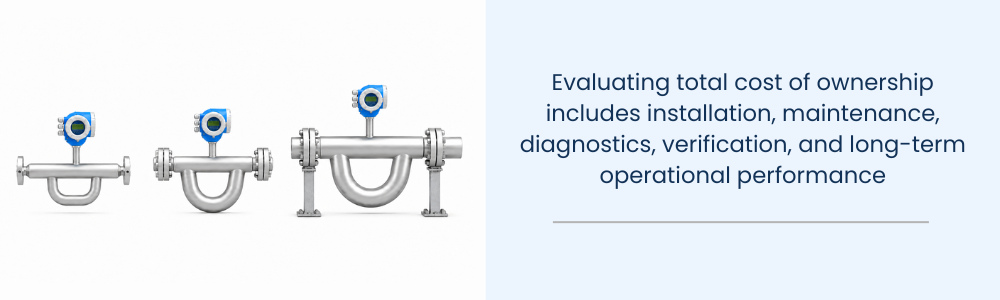
Total Cost of Ownership: Look Beyond the Meter Price
One of the most common misconceptions about Coriolis meters is that they are too expensive.
That concern is understandable. If Coriolis is compared only as a line item against a more familiar meter technology, the upfront cost can stand out.
It is true that the upfront meter cost can be higher, especially in larger line sizes. Mike specifically noted that large-diameter Coriolis meters can represent a significant capital cost.
But upfront cost is only one part of the decision.
Customers should also consider:
- Piping and installation cost
- Required upstream and downstream pipe runs
- Maintenance requirements
- Mechanical wear
- Downtime risk
- Diagnostic and verification capabilities
- Reverification requirements
- Lead time and project schedule
- Long-term operational confidence
As Mike explained, the sticker price can look different when the whole system is taken into account. With no moving parts, built-in diagnostics, and simplified installation in some applications, Coriolis meters may offer value that is not visible in a one-to-one meter comparison.
His advice for hesitant customers was direct: “Don’t look at the upfront cost. Look at the total cost of ownership.”
Questions to Ask Before Choosing Coriolis
Before selecting a Coriolis meter, utilities and contractors should ask:
- Is this a custody transfer application where Measurement Canada-approved technology is required?
- What approvals or compliance requirements apply to this installation in Canada? (i.e. Hazardous Location, CRN, etc.).
- Is installation space limited, or are we looking to reduce piping complexity?
- What are the minimum, normal, and maximum flow rates the meter will need to handle?
- How do seasonal demand changes affect the expected operating range?
- What pressure and flow conditions should be considered during meter sizing and selection?
- What level of measurement accuracy and confidence is required?
- What is the gas composition today, and could it change in the future?
- Would advanced diagnostics and condition monitoring provide additional operational value?
- What is the total cost of ownership when installation, maintenance, diagnostics, and lifecycle performance are considered?
These questions help determine whether Coriolis is the right fit or whether another technology, such as ultrasonic, turbine, rotary, or diaphragm metering, is better suited.
The Future of Coriolis Metering in Canada
Coriolis metering is not new technology, but its role in Canadian natural gas distribution is still developing.
As utilities face longer lead times for some traditional metering technologies, growing interest in hydrogen blending, pressure to improve operational efficiency, and higher expectations for measurement confidence, Coriolis meters are likely to become more familiar.
Mike expects adoption to grow, especially as more customers learn how the technology works and where it fits.
For CR Wall, the opportunity is education. Coriolis will not be the answer for every application, but it deserves a place in the conversation when customers are evaluating high-accuracy, low-maintenance, compact, and diagnostic-rich metering options.
Final Takeaway
Coriolis metering provides Canadian natural gas utilities and contractors another tool to solve modern measurement challenges.
It offers direct mass flow measurement, strong accuracy, no moving parts, onboard diagnostics, compact installation, and potential value in future hydrogen blend applications.
At the same time, it requires proper sizing, approval review, pressure drop evaluation, and total cost of ownership analysis.
The best way to evaluate Coriolis is not to compare it on meter price alone. It is to look at the full application, the full installation, and the long-term operating requirements.
That is the real value of the technology. Coriolis is not just a more accurate meter. In the right application, it can help reduce uncertainty across measurement, installation, maintenance, and future fuel readiness.
As the Canadian natural gas industry continues to modernize, Coriolis metering may become an increasingly important part of safe, accurate, and efficient gas measurement.
Interested in learning more about Coriolis metering for natural gas applications?
Explore Coriolis Meters on ShopCRWall.com
Connect with CR Wall to discuss your application, understand your options, and explore whether Coriolis technology is the right fit for your next project.