

Moisture Measurement in Canadian Natural Gas: What Transmission and Distribution Operators Need to Know

Even “dry” natural gas can still contain enough moisture to cause problems when pressure, temperature and operating conditions change. For Canadian operators, knowing where moisture becomes a risk, and whether the measurement can be trusted, plays an important role in protecting gas quality and system reliability.
We spoke with Joshua Tolley of Endress+Hauser, who manages the Analytical Business in Western Canada, to explore where moisture issues show up, how to measure them accurately, and what operators can learn from the data before small issues become costly ones.
Why Moisture Still Matters in “Dry” Natural Gas
Natural gas is typically dehydrated before entering a transmission system, but “dry” does not mean moisture-free.
As Tolley explained:
“People use the term dry, but that doesn’t actually mean that there is no water.”
Under the right pressure and temperature conditions, moisture can contribute to hydrate formation, restrict flow, interfere with equipment and increase corrosion risk, particularly when CO₂ or H₂S are present.
Moisture can also become a commercial issue. Gas entering a pipeline has to meet that system’s gas-quality requirements, and an off-spec moisture reading can ultimately affect whether that gas is accepted at all.
Moisture Specifications Can Vary Between Canadian Pipelines
A moisture reading that is acceptable on one Canadian pipeline may not meet the requirements of another.
Requirements are usually set by the receiving pipeline’s tariff, gas-quality specification or commercial agreement. Operators need to understand the requirements at their specific receipt, delivery or custody-transfer point, where ownership or commercial responsibility for the gas changes.
A commonly referenced value in Canadian applications is 4 lb of water per million standard cubic feet of gas, approximately 84 ppmv, but this is not a universal Canadian requirement. The applicable tariff or agreement should always be confirmed.
Moisture can also be reported in several ways, including:
- ppmv, or parts per million by volume
- Mass concentration, such as mg per standard cubic metre
- Water dew point, the temperature where water begins to condense at a stated pressure
- lb/MMscf, pounds of water per million standard cubic feet
The number itself is only part of the picture. Pressure and temperature matter too.
What Happens to Moisture When Pressure and Temperature Change?
Gas that looks perfectly acceptable at one operating condition can behave very differently after a pressure drop or a cold Canadian night. As temperature falls, natural gas moves closer to its water dew point, while pressure changes can create additional cooling at regulators and pressure-reduction points.
One reason is the Joule-Thomson effect, where the temperature of natural gas can fall as its pressure is reduced. If the gas cools enough, liquids may begin to come out of the gas phase.
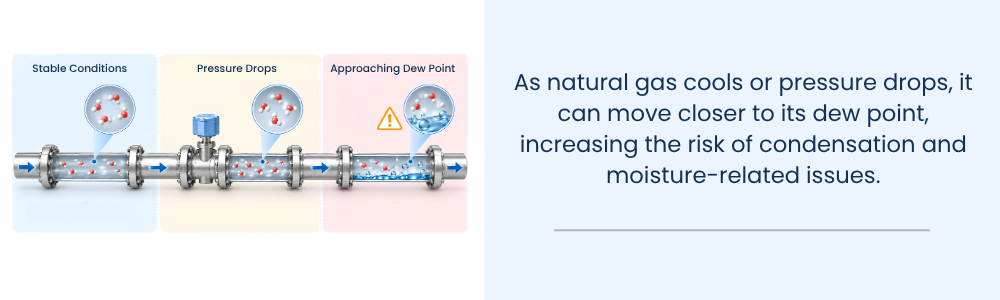
That makes this especially relevant in Canada. Cold ambient conditions can reduce the surface temperature of sample tubing, regulators, valves, and other exposed equipment, causing the gas temperature to drop.
Hydrocarbon dew point, the temperature at which hydrocarbons begin to condense into liquid, also matters. Natural gas contains more than methane, so keeping the sample warm enough is important for maintaining a representative measurement from the process tap to the analyzer.
Where Does Moisture Measurement Provide the Most Value?
Not every point in a natural gas system needs the same level of moisture monitoring. A useful way to decide where measurement matters most is to ask one question: Where is the consequence of getting it wrong the highest?
As Tolley put it:
“Measure where your consequence is the highest.”
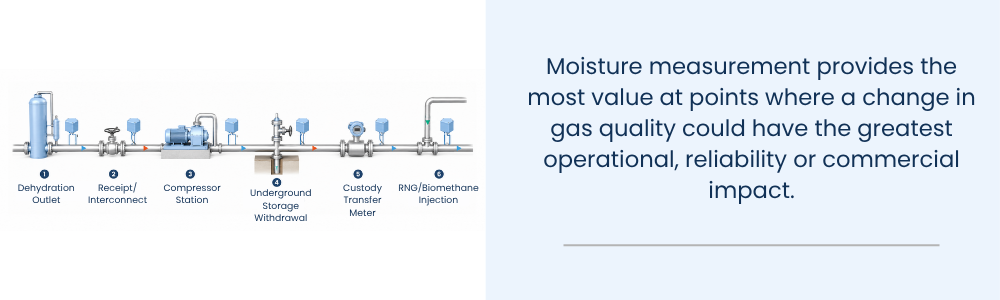
Important measurement points can include:
- Dehydration unit outlets
- Pipeline receipt and interconnect points
- Custody-transfer locations
- Compressor stations
- Underground storage withdrawal points
- Renewable natural gas (RNG) and biomethane injection points
Underground storage is a good example. Gas can pick up additional moisture while stored, making measurement and dehydration important when it is withdrawn and returned to the system.
Continuous monitoring becomes particularly valuable when an excursion could quickly affect gas quality, reliability, safety, or a contractual requirement. Periodic testing may still make sense in stable, lower-risk applications.
Why Your Moisture Analyzer Is Only as Good as the Sample System
One point came up repeatedly during our conversation with Tolley:
“Your analyzer is only ever as good as your sample system.”
Water molecules can interact with the surfaces inside sample tubing, particularly at very low concentrations. That can slow down how quickly a change in the process reaches the analyzer.
But what if the gas reaching your analyzer is already 20 or 30 minutes old?
Tolley has seen applications where long sample lines and excessive volume created exactly that problem. The analyzer itself may have been working properly, but the sample reaching it no longer represented what was happening in the pipeline in real time.
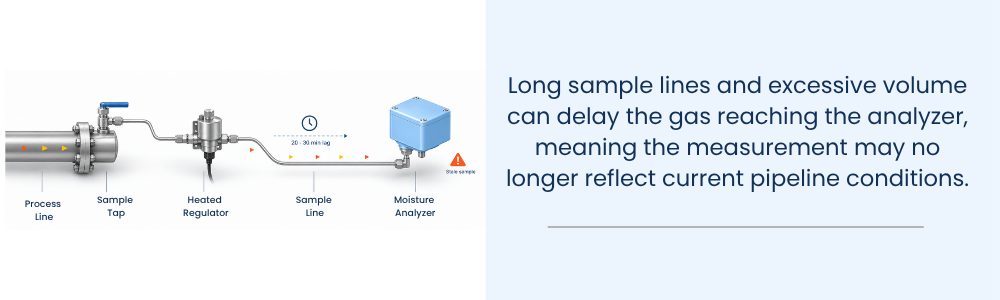
If an operator is trying to troubleshoot a gas-quality change, a 20-minute-old sample is not giving them a real-time answer.
Common issues include:
- Long or oversized sample lines
- Excessive dead volume
- Incorrect pressure or flow
- Regulators located too far from the sample point
- Inadequate heating
- Joule-Thomson cooling
- Condensation inside the sample system
Where appropriate, a heated regulator should be positioned close to the sample point, sample volume should be minimized, and the gas should remain above its relevant dew point.
The key takeaway is that the moisture analyzer and sampling system should be treated as one complete measurement system.
Moisture Data Can Tell You More Than Whether Gas Is In Spec
A moisture analyzer can tell operators much more than whether the gas is simply in or out of specification.
Continuous trending can reveal what is changing in the process before that change becomes a larger problem.
A molecular sieve, which uses an adsorbent material to remove moisture from natural gas and achieve very low water concentrations, is a good example. As the bed becomes saturated, moisture begins to appear at the outlet. This is known as breakthrough, and once it begins, moisture levels can rise quickly.
As Tolley described it:
“You see a little bit of moisture and then all of a sudden you see full moisture.”
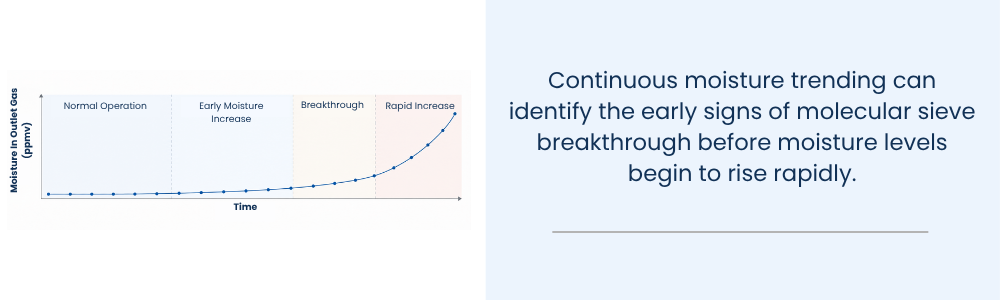
Catching that breakthrough early gives operators a better picture of when the bed actually needs to be switched and regenerated, allowing them to maximize bed utilization, improve operating efficiency, and reduce operating costs.
Trending can also reveal seasonal changes, storage effects, process upsets and short moisture excursions that periodic testing may miss or misinterpret.
Choosing the Right Moisture Measurement Technology
When selecting a moisture measurement technology, Tolley’s advice is straightforward:
“Start with the application, not the analyzer.”
Operators should first define what the measurement needs to do. Key considerations include measurement range, accuracy, response time, gas composition, contaminants, pressure and temperature conditions, hazardous-area requirements, communications, maintenance needs and total cost of ownership.
Maintainability is an important part of that decision. Endress+Hauser’s TDLAS analyzer portfolio is designed with maximum uptime and field serviceability in mind, helping operators reduce downtime and simplify maintenance in the field.
Within that portfolio, three analyzers serve different gas-quality applications:
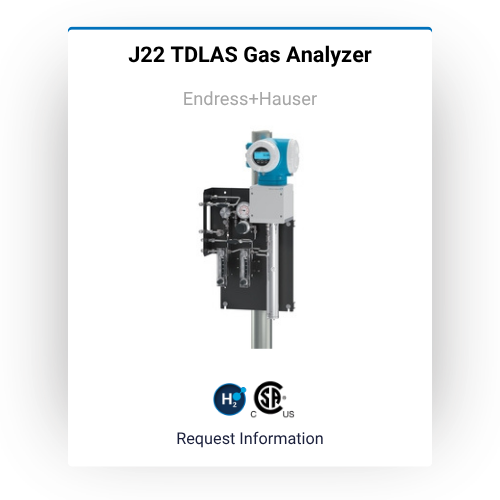
J22: Designed for moisture measurement from 0 to 6000 ppm, and typically used for sales gas and glycol dehydration applications.
JT33: Designed for H₂S measurement from 0 to 500 ppm, and commonly applied in sales gas applications.
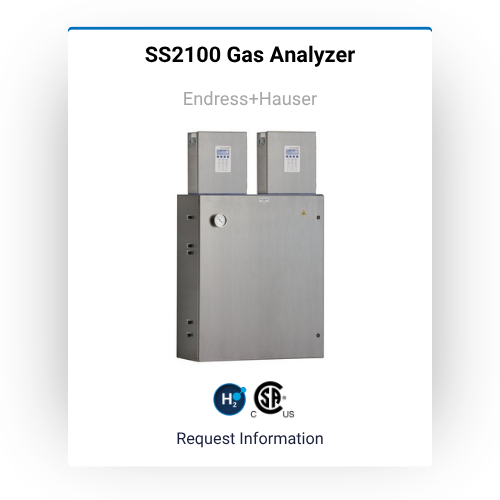
SS2100: Used for trace moisture measurement, and can also be configured to measure CO₂, H₂O and H₂S individually or in a cost-effective multi-analyte analyzer package. O₂ measurement can also be added depending on the application.

For operators evaluating a measurement solution, the best fit comes back to the application itself, including the required measurement range, gas composition, contaminants and the design of the complete sampling system.
What RNG and Biomethane Mean for Gas Quality Measurement
As new gas sources enter Canadian networks, operators may be dealing with more variability in gas composition than they have in the past.
Renewable natural gas (RNG) and biomethane can introduce different gas compositions and impurities than conventional natural gas. At these injection points, moisture becomes part of a broader gas-quality picture that can also include H₂S, oxygen, CO₂ and heating value.
Tolley recommends thinking beyond today’s requirements when selecting measurement technology.
“If specifications do change over time and become tighter, then you’re prepared.”
For operators, that means considering whether a measurement system can support the accuracy, diagnostics and flexibility that may be needed as gas sources and pipeline requirements continue to evolve.
Three Priorities for Better Moisture Management
If there are three points to take away from the conversation, they are these: treat the sample system as part of the measurement, measure where the consequence of an excursion is highest, and use moisture data for more than compliance.
Moisture may only make up a small part of the gas stream, but when it is not understood or measured properly, the operational consequences can be much larger. Reliable measurement helps operators protect gas quality, troubleshoot changes and make better decisions about how their system is operating.
Have questions about moisture measurement in your natural gas system? CR Wall works with Endress+Hauser to support Canadian transmission and distribution applications, from selecting the right analyzer to understanding the sampling system around it.